

Blog
Enriching Product Data with AI
Your product range is growing, your channels are growing, and demands are growing. Your team isn’t—and that’s why enriching product data with AI is no longer an experiment for B2B organizations, but a strategic choice.
Scroll down for positive impact
Date

Your product range is growing. Your sales channels are growing. The demands from customers, regulations, and search engines are growing. But what about your team? It’s been at the same level for years. That’s not a capacity problem—it’s a scalability problem. And that’s exactly why enriching product data with AI is becoming an increasingly serious priority for B2B organizations in the manufacturing and wholesale industries. Not as an experiment, but as a strategic choice.
Why Enriching Product Data Is a Scaling Problem
Does this sound familiar? A new product line needs to be launched. The descriptions are in an Excel file from the supplier, the specs are scattered across three systems, and someone on your team has to transfer them manually. Then comes a briefing via email, a round of revisions with a copywriter, translations that take weeks to arrive, and finally, an import error that sends you right back to square one.
This is no exception. Manually processing product data is still the standard procedure at many organizations. And it works—until it doesn't.
A PIM system is the logical foundation for centralizing product data, but it is also just the beginning. As organizations serve more SKUs, more channels, and more markets, the structure and completeness of product data become critical. Incomplete or inconsistently structured data not only produces poor AI output, but also results in poor automated output at scale.
That’s the tipping point. More products, more features, more channels—and the same people. At some point, it simply becomes impossible to keep up using the same approach.
How agentic AI differs from a simple AI button
Many software vendors add AI as an extra feature—a suggestion here or a translation button there. It’s useful, but it doesn’t solve the underlying problem. People are still involved in every step of the process.
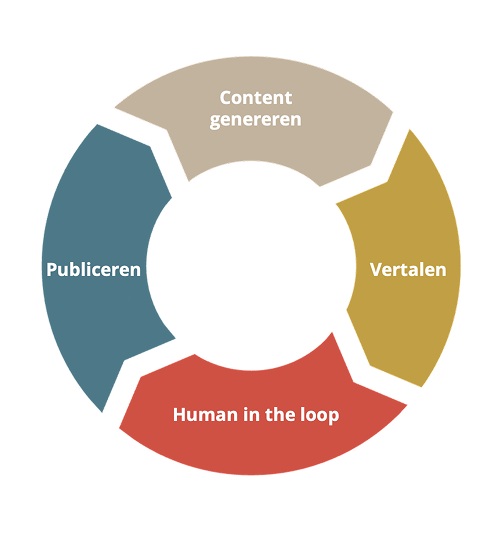
Agentic AI works differently. Instead of providing support for a task, an AI agent performs the task independently: generating, translating, validating, and publishing content. Humans set the parameters and approve the results at the moments that matter.
While traditional PIM automation relies on fixed rules, agentic AI goes a step further: AI agents reason, plan, and perform complex tasks independently. This includes extracting, classifying, enriching, and validating product information from unstructured sources such as supplier PDFs and spreadsheets—and then optimizing that information for each sales channel.
The difference isn't the technology. It's the way we work.
Enriching Product Data with AI in Practice
During a recent session with clients, we demonstrated how AI agents work in a PIM environment. The focus was specific: how to make ten products without product descriptions available in multiple languages.
What would normally take hours or days was completed in just a few minutes. An agent was tasked with generating product descriptions in Dutch based on the available technical specifications (power, voltage, IP rating, rotational speed). A second agent then translated the texts into French, including a glossary of technical terms that would otherwise be mistranslated.
The result is the ability to manage multilingual product data and translate product descriptions consistently without involving a copywriter or translation agency.
What didn’t change: the review process. Every piece of text generated was reviewed by a human before it was added to the catalog. Quality, brand consistency, and accountability remain the work of humans. That is precisely the role of the “human in the loop”—not as a formal step, but as a logical checkpoint at the moments that truly matter.
PIM tools, such as Sales Layer, already offer this agent functionality out of the box, but the principle applies across all platforms. Whether you work with Inriver, Akeneo, or another PIM solution, product managers and sales teams are increasingly able to set up complex automation—including autonomous agent-based AI processes—without coding knowledge or reliance on IT.
It offers more than just speed
The business case for enriching product data with AI goes beyond just saving time. Here are a few concrete observations from real-world experience:
- New languages that will go live in five days instead of sixteen
- Up to three times more output with the same team
- Significantly lower translation costs by replacing agencies with trained AI agents equipped with subject-specific glossaries
According to a survey of B2B organizations that have integrated AI into their product information processes, more than 80% report moderate to significant revenue gains, and 87% see an increase in customer trust in their product data.
But there is a deeper reason why this is urgent right now.

The search bar is changing. Is your product data changing too?
For the first time in 25 years, Google is making fundamental changes to its search bar. AI answers longer questions, compares products, and makes recommendations for both consumers and B2B buyers. This is changing the way products are found and chosen.
If an AI agent searches for a product based on its specifications, but the context, scope of application, or compatibility are not explicitly stated in the product information, the product will simply not be selected—even if it meets all the requirements in practice.
Good product data is therefore not just an internal efficiency issue. It’s about your visibility in a world where AI is increasingly serving as the gateway to your product lineup. Inconsistent or incomplete product information can frustrate human shoppers, but AI-driven recommendations and automated purchasing workflows depend on it to function properly.
Where do you start?
Using AI to ensure product data consistency doesn’t have to be a major implementation project. The first step is to identify where the most repetition occurs in your current product information process. Which tasks are time-consuming, relatively simple, and performed the same way over and over again?
Those are the tasks for your first agent.
Start small: one agent, one task, one product group. Evaluate the results. Refine the instructions. Build confidence in the process before scaling up. A strategic approach always starts with a solid data foundation. Make sure your product data is consistent and well-structured before implementing AI capabilities.
If you'd like to see how this would work in practice for your product line and processes, please contact us.
Download our white paper

Do you want to use AI in B2B commerce without losing your buyers' trust?
Discover the product data and governance foundations you need for reliable AI in search, personalization, and assistance.

By Tom Heinen
Business Development


Let's create positive
impact together!
Our information
Brouwerijstraat 1-A1
7523 XC Enschede
Certifications


