

Blog
Reliable AI solutions for B2
B2B commerce
In B2B, it’s not just about an answer—it’s about an answer you can verify. Learn more about using guardrails, data requirements, and the role of PIM.
Scroll down for positive impact
Date

"Our AI assistant speaks fluently... but will customers trust it?"
Is AI the fast track to better self-service in a B2B organization? A chatbot that answers questions, an agent who recommends the right products, or AI-powered search that “understands what the customer means.” But as soon as the AI provides a plausible answer that’s just slightly off, trust is lost—and with it, adoption. In B2B, the costs of errors are simply higher because incorrect specifications, compatibility issues, or availability directly impact processes, orders, and customer relationships.
At the same time, the reality is harsh. AI projects often fail not because of the model, but because of the data behind it. Gartner predicts that by 2026, organizations will abandon 60% of AI projects if they are not supported by AI-ready data.
What does trust mean in B2B with AI?
In B2B, trust isn’t about “sounding human.” It’s about three things:
- Accuracy: Does the answer match the actual product details (specifications, variants, compatibility)?
- Verifiability: Can you trace back why this answer was given and what source data was used?
- Consistency within business rules: Does the response comply with contractual agreements, product range policies, and availability (what is this customer allowed to view/purchase, and under what conditions)?
Trust in B2B is built through a structured purchasing process, traceability, and alignment with business rules—not through “pretty” output.
Transparency is the standard
From “AI Answers” to “AI Justifies”
Providing insight into how AI arrives at an answer and where that answer comes from is essential. In e-commerce, this essentially means citing sources for product data, rules that define the answer, and logic that can be audited.
That’s not just about compliance. It’s also a prerequisite for adoption. Organizations that use AI regularly encounter inaccurate or misleading output. In addition, we see that there are significant concerns regarding security, privacy, and compliance when it comes to AI output in practice.
In addition, governance is emerging as a design requirement. The EU AI Act introduces transparency obligations for certain AI systems (for example, when people interact with AI) and establishes governance structures for oversight. As a result, explainability and accountability are increasingly becoming the norm.

The use of AI must be strictly regulated
B2B commerce has additional layers that AI must take into account; otherwise, it immediately comes across as unreliable. Just think about:
- Contract pricing & customer agreements: the right product at the right price for the customer.
- Product access rights: Customer A can view Product X, but Customer B cannot.
- Availability & Delivery Terms: What is available, where, when, and under what conditions?
- Compatibility & safety: An incorrect attribute or the wrong variant can disrupt downstream processes.
A common scenario is when an AI assistant recommends a “matching” part but overlooks a compatibility rule or a variant attribute. The customer places an order and later discovers that it doesn’t fit. This erodes trust in the AI, but more importantly, in the organization.
AI highlights data issues but does not automatically resolve them.
Common causes of unreliable AI output in commerce
In practice, this is where things sometimes go wrong:
- Incomplete or unstructured product data. Important specifications are contained in plain text or PDFs.
- Multiple “sources of truth” (ERP/PLM/PIM/spreadsheets) containing conflicting values.
- No clear ownership. No one is responsible for end-to-end product data quality.
- Governance exists only on paper. Validation rules and workflows are in place but are not consistently applied.
- AI without context rules: the AI is allowed to provide answers outside the scope of contracts, product ranges, or availability, and that immediately feels “wrong.”
Organizations sometimes underestimate the difference between traditional data management and AI-ready data, and without that foundation, AI initiatives are bound to fail.
The Role of PIM and Integrations
Having or generating large amounts of data is not an end in itself. However, ensuring that data is usable for both AI and auditing is. Consider the following:
- Structured attributes (not hidden in text).
- Relationships/variants explicitly modeled (compatibility, bundles, substitutes).
- Metadata & traceability: you know where values come from and when they were changed.
- Governance workflows—including review, approval, and audit trails—have been established, particularly for critical attributes.
A PIM is where you ensure this by serving as a centralized and controlled source for products. AI uses that source for discovery, personalization, and agentic commerce, which makes it reliable.

Examples of safeguards for customer-centric AI
If you use AI in a customer-centric way, treat it as an assistant that operates within certain guidelines, not as a standalone chatbot. Here are some practical guidelines:
- Citation per answer: indicate which product data or source it is based on.
- Work within the customer's context: contract prices, product range rights, and availability serve as strict limits.
- Human-in-the-loop for critical information: let AI make a recommendation, which a human then approves (or AI automatically escalates the matter).
- Confidence + “I don’t know”: if data is missing or too uncertain, the AI must explicitly state this and refer the user elsewhere.
- Logging & audit trail: log prompts, sources, product data versions, and output so you can analyze and improve.
- Validation rules in the data layer: ensure that critical attributes (safety/compatibility) cannot be generated “freely” without verification.
- Roles and permissions: Give internal teams more “access” than external buyers (not everything is public)
Where do you start?
Most improvements don't start with technology, but with insight:
- Where does your product information come from?
- Where do differences arise?
- Which data is authoritative and which is not?
From there, you start where the impact is measurable and the risk remains manageable. Consider using AI for internal support—such as accelerating the creation of product content, improving search synonyms, or preparing responses with source references that an employee approves.
Choose one category or product line and make it “AI-ready” by establishing clear attribute standards, ownership, and review workflows. Making data AI-ready is an iterative process that involves metadata and governance, which you need to develop on a case-by-case basis.
By taking a step-by-step approach, you’ll build trust with stakeholders and ensure that AI doesn’t expose the problem, while keeping it under control.
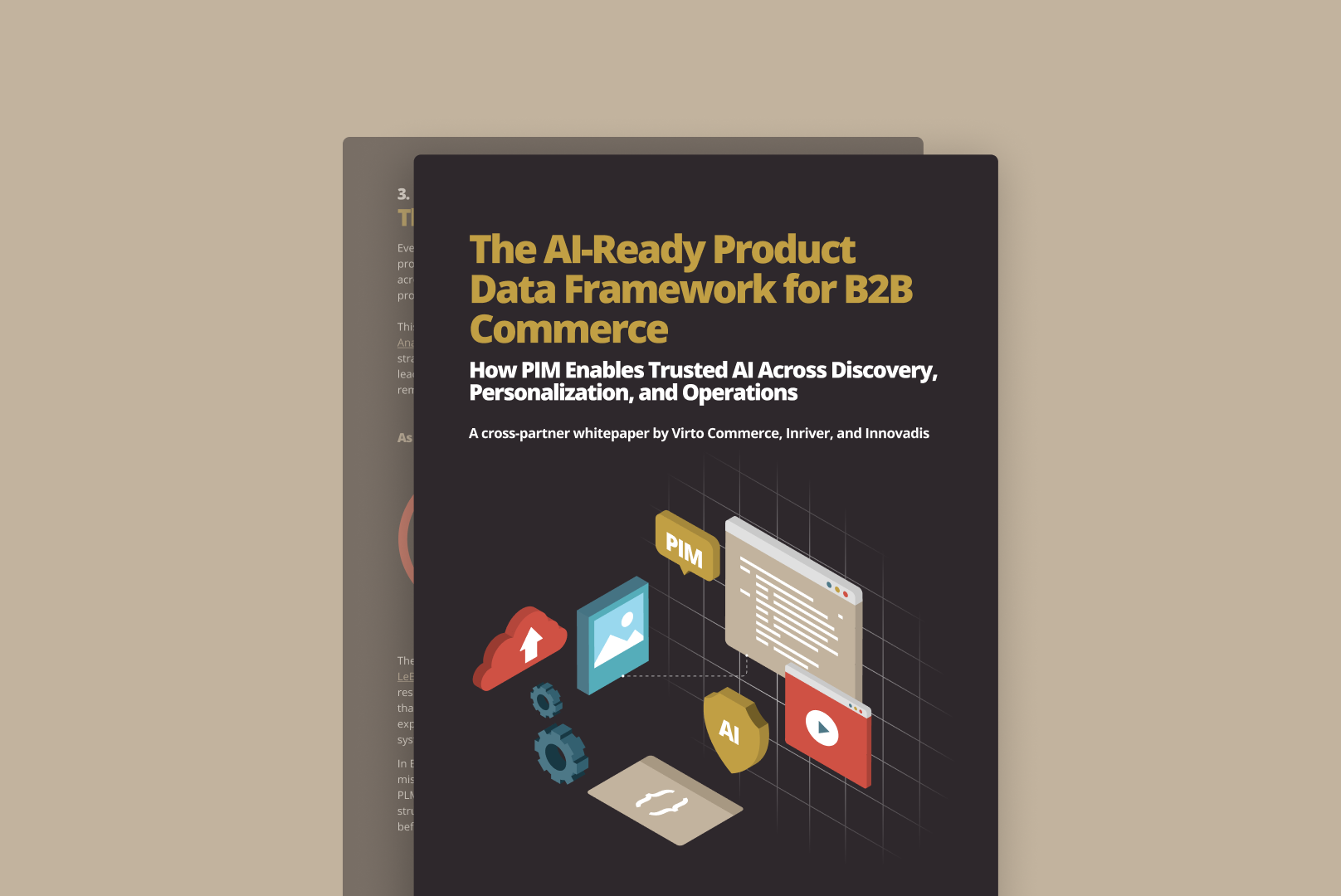
Download our white paper

Do you want to use AI in B2B commerce without losing your buyers' trust?
Discover the product data and governance foundations you need for reliable AI in search, personalization, and assistance.

By Tom Heinen
Business Development


Let's create positive
impact together!
Our information
Brouwerijstraat 1-A1
7523 XC Enschede
Certifications


